Nobody Summits Without Base Camp: The Case for Slowing Down on Purpose
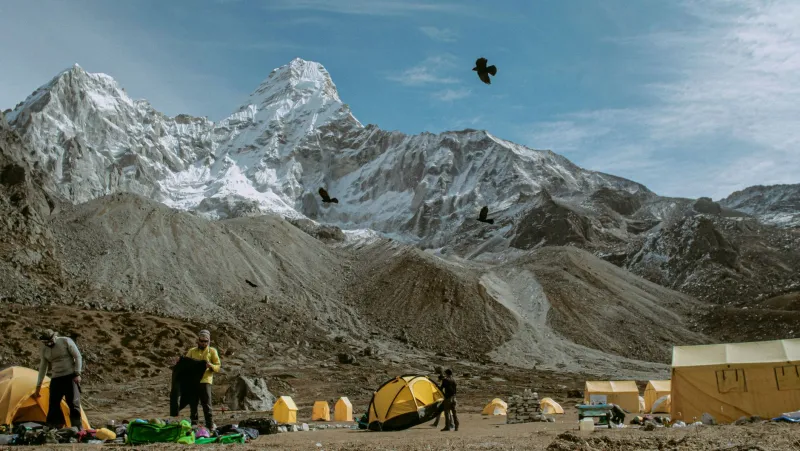
Here's an uncomfortable pattern I keep seeing: someone signs up for a course, sets a finish date, grinds for six weeks, and then vanishes. Not because they're lazy. Because they planned like a tourist when they should have planned like a mountaineer.
Ask any climber who's been above 20,000 feet and they'll tell you the same thing: summits don't kill climbs — bad acclimatization does. You don't go from trailhead to peak in one push. You establish base camp, you climb partway up and come back down, you sleep low, you climb higher, you sleep higher. The descending is as important as the ascending. Your body literally cannot adapt without the down days.
Most learners never build a single down day into their plans. And then they wonder why they got altitude sickness of the ego.
The Tyranny of the Summit Goal
Summit goals sound noble: finish the bootcamp by March. Pass the PMP exam. Publish the portfolio. They're measurable, they're motivating, and they're almost perfectly designed to produce burnout.
Why? Because a summit goal gives you zero guidance about pace, recovery, or what to do when you stall. It's a destination without a route. When motivation dips — and it always dips around week three — the only tool in your kit is "try harder," which is not a strategy. It's a denial of physiology.
Mountaineers figured this out the hard way, decades ago. The reason more people summit Denali now than in 1950 isn't better gear alone. It's that expeditions learned to respect acclimatization windows: climb high, sleep low, rest deliberately. Progress isn't linear, so the plan can't be either.
Build Base Camps Into Every Goal
A base camp, in learning terms, is a checkpoint where you consolidate instead of climb. Here's what that looks like in practice:
Checkpoint skills. Instead of "finish 12 modules," define capabilities: "I can build a responsive webpage from scratch without a tutorial." When you hit it, you don't just move on — you prove it to yourself. Build the thing. Teach it to a friend. Write the blog post. Consolidation is where learning actually solidifies.
Acclimatization projects. Between courses or units, take a week or two to work on something slightly below your frustration threshold. If you just finished a Python fundamentals course, spend two weeks building small, easy scripts before jumping into advanced material. It feels like slacking. It's actually encoding.
Planned plateaus. Yes, schedule them. A deliberate plateau — a week at the same difficulty level with regular practice — lets your brain catch up to your ambition. The alternative is the unplanned plateau, which arrives anyway, except now it comes wrapped in shame.
Rest as a line item. If your study plan has no white space in it, it's not a plan. It's a countdown to quitting.
The Descent Nobody Talks About
Here's the part the motivational posters skip: after you hit the goal, there's a crash. Climbers call it post-summit letdown. Learners call it "now what?"
Finishing a certification and immediately feeling empty isn't a character flaw — it's the predictable result of planning only for the peak. Smart expeditions plan the descent with the same care as the ascent. Smart learners do too: before you finish a course, decide what the next gentle climb looks like. Not a bigger summit — a base camp for the next one.
A Quick Audit
Look at your current learning goal and ask:
- Do I have at least two checkpoints between here and "done"?
- Have I scheduled any consolidation time, or only acquisition time?
- What's my plan for the week after I finish?
- If I stall for two weeks, does my plan survive, or does it collapse?
If you answered badly to two or more, you don't need more motivation. You need a base camp.
The summit will still be there. The learners who actually reach it aren't the ones who climb fastest — they're the ones who understood that slowing down on purpose is how you keep climbing at all.